Ecommerce web design has one honest success metric, and it is not conversion rate. Conversion rate goes up when you discount and down when you raise prices, which makes it useless on its own. We optimise revenue per session, because it is the only number that cannot be gamed by making the business worse.
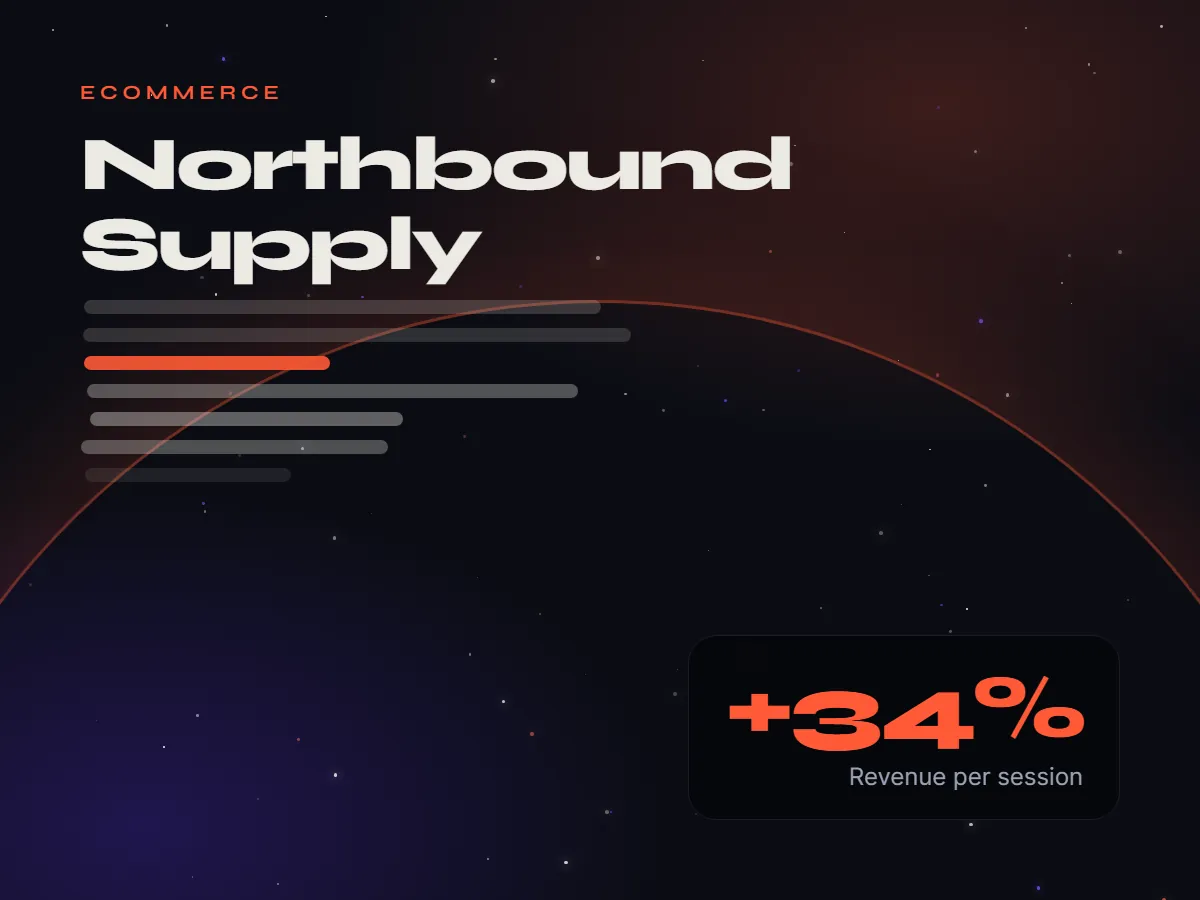
The single biggest lever we find on most stores is the catalogue structure. Merchants tend to organise products the way their suppliers do — by brand, by manufacturer, by internal category. Customers do not think that way. They arrive with an occasion, a season, a problem, or a person to buy for. When we rebuilt Northbound Supply around activity and season instead of manufacturer, the share of visitors using site search as a navigation workaround fell by 61%, and revenue per session rose by a third.
The second lever is speed, and it is unforgiving on mobile. A product page that takes four seconds to become interactive loses a measurable share of buyers before they see the price. We ship product pages as static HTML with hydrated islands only where they earn it — variant pickers, cart drawers, live stock — and serve every product image as AVIF at the exact rendered dimensions, with an explicit aspect ratio so nothing shifts as it loads.
The third is the checkout, where the correct instinct is restraint. We remove fields, defer anything that is not needed to take payment, keep the order summary visible throughout, and never surprise anyone with shipping cost after they have committed. On Shopify we work inside the platform rather than around it, because a custom checkout that breaks on every platform update is a liability disguised as a feature.
We build on Shopify when you need its payments, tax and fulfilment ecosystem, and on a headless Next.js storefront when your catalogue or content needs outgrow it. We will tell you honestly which one you need, including when the answer is that your current platform is fine and the problem is the design.
If this is not quite the shape of your problem, the services overview compares all four engagements side by side, and the FAQ covers cost, revisions and code ownership.